
Published in Advanced Science
Innovative Structure Design
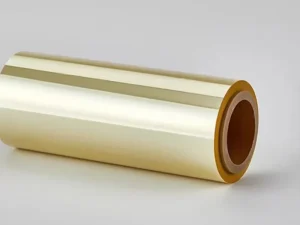
In a significant advancement for next-generation electromagnetic interference (EMI) shielding materials, a collaborative research team has developed a novel aramid nanofiber (ANF)/MXene composite film featuring an interpenetrating layered structure. Published in the journal Advanced Science, this work addresses the critical challenge of balancing high electrical conductivity with long-term environmental stability in flexible shielding materials.
The team, led by researchers including Yuezhan Feng and Hao-Bin Zhang, devised an innovative directional freeze-thaw intercalation and gel film formation strategy. This process first creates a 3D interconnected honeycomb scaffold from ANF solution via directional freezing. After thawing and solvent exchange to form a hydrogel, the scaffold is immersed in a MXene solution, allowing MXene nanosheets to infiltrate the porous network. Finally, hot-pressing densification yields a film with distinct, interpenetrating ANF and MXene layers (termed A@M).
Breakthrough Performance
This unique architecture solves a key problem found in traditional uniformly mixed films, where insulating polymer components disrupt the connectivity of the conductive filler network. Here, the continuous MXene layers form an efficient electron transport pathway, achieving an excellent electrical conductivity of 5630.8 S/m at approximately 40 wt.% MXene loading. Consequently, the film exhibits an outstanding EMI shielding effectiveness of 43.3 dB—far superior to its uniformly mixed counterpart—effectively blocking over 99.99% of incident electromagnetic radiation across the X, Ku, and K bands.
Exceptional Durability
Beyond its shielding performance, the design leverages the inherent strengths of aramid. The continuous ANF layers act as a high-strength mechanical skeleton, providing a tensile strength of 121.0 MPa. Crucially, these ANF layers fully encapsulate the MXene, forming a physical barrier against oxygen and moisture. This imparts remarkable long-term antioxidant stability; after 80 days of exposure to air, the A@M film retained 90% of its original EMI performance, a stark contrast to the rapid degradation seen in control samples.
This work presents a scalable strategy for creating durable, high-performance EMI shielding materials, promising significant applications in aerospace, defense, and next-generation flexible electronics where both robust protection and long service life are paramount.
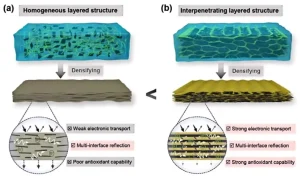
Structure of Interpenetrating ANF/MXene Layered Films
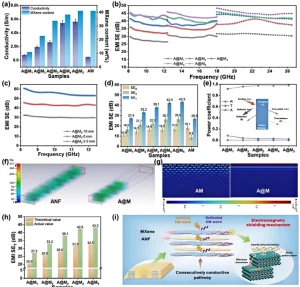
Electromagnetic Interference Shielding Performance of Interpenetrating ANF/MXene Layered Film